
Birds in This Story
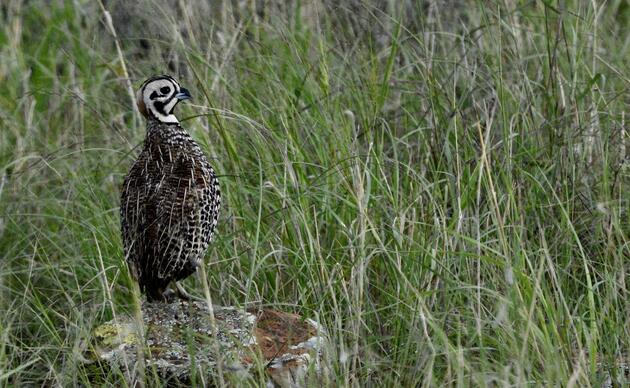
Montezuma Quail
Latin: Cyrtonyx montezumae

Brewer's Blackbird
Latin: Euphagus cyanocephalus

Northern Harrier
Latin: Circus hudsonius

Golden Eagle
Latin: Aquila chrysaetos

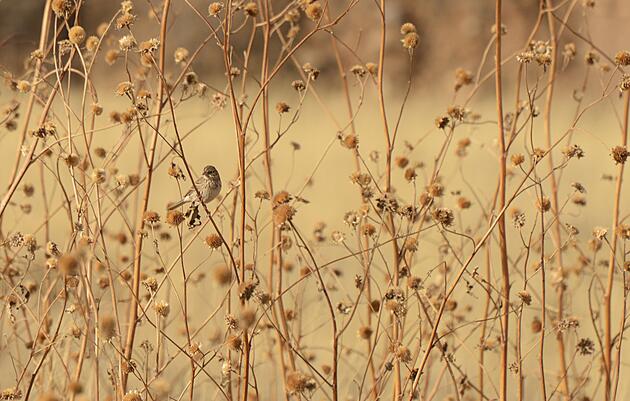
Grasshopper Sparrow
Latin: Ammodramus savannarum

American Kestrel
Latin: Falco sparverius

Loggerhead Shrike
Latin: Lanius ludovicianus

Eastern Meadowlark
Latin: Sturnella magna

Gambel's Quail
Latin: Callipepla gambelii

Scaled Quail
Latin: Callipepla squamata

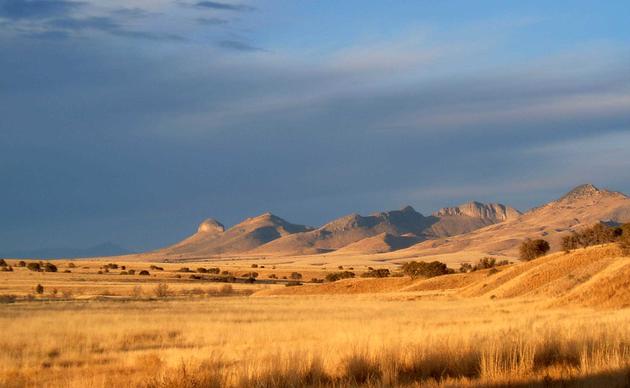
At the start of each new year, volunteers grab their binoculars and head into the field to count birds across a 15-mile-wide circle centered near the northeast corner of the Appleton-Whittell Research Ranch. From the foothills of the Huachuca Mountains to the grasslands of the Sonoita Plain, they count every bird they hear and see.
Now in its 20th year, this count is our annual contribution to the Christmas Bird Count (CBC), a nation-wide community science effort that’s been providing insight into the health of birds and their habitats since 1900. Using data from CBCs and other annual counts, researchers can describe how bird populations have changed in time and space over the last century, and this information can be put to work informing conservation action and materials like Audubon’s 2019 Climate Change Report and the North American Bird Conservation Initiative’s 2025 State of the Birds Report.
While this high-level approach is key to truly making sense of CBC data, there are still plenty of stories to be told from the perspective of a single count. Whether looking at a single species, at the numbers at large, or through the eyes of volunteers, each Appleton-Whittell CBC offers lots to learn and celebrate!
Looking at the Numbers
Most broadly, we can summarize data across species and look at the total number of individual birds observed during each count. From this perspective, we see a lot of variation with a slightly upward overall trend. The total, which averages around 5,000 birds, saw its peak during the first year of the count with nearly 9,000 birds and its low in 2016 with under 3,000 birds. This year, surveyors counted nearly 8,000 birds – the third highest count over the circle's 20-year history. Keeping in mind that the overall number of birds can be driven by just a handful of gregarious species (one relocated flock of Brewer’s Blackbirds could skew the count by 2,000 birds!), we don’t think this metric gives cause for celebration or alarm.
Instead of the number of individuals, we can focus on the number of species, also called “species richness”, observed in the count circle. From this perspective, we see a slightly downward trend with a high of 119 species in 2008 and a low of 89 in 2024. This year, surveyors observed 98 species – just a bit below the average of 102. Notably missing birds include waterfowl, shorebirds, and several warbler species. This is no surprise given drought conditions across the count circle where waterfowl and shorebirds would struggle to find adequate surface water and insect-loving warblers would find food resources scarce.
Focusing on Priority Species
Digging more deeply, we can focus on priority species, or species of conservation concern that we in our region have an outsized responsibility in protecting. It’s easy to want to look at a single year’s data and jump to sweeping conclusions, but a better approach is to look at trends over time.
For example, take the Montezuma Quail, a regional favorite that adorns most Research Ranch collateral, and its relatives the Gambel’s and Scaled Quail. Concerningly, the data reveal a steep downward trend in all three species since 2024, likely the outcome of ongoing drought. However, the data also provide some hope, showing that these birds have an incredible ability to rebound after rough years – each has had totals as high as 100 and as low as zero over the years.
Another priority species, the Chihuahuan Meadowlark, provides a similarly mixed story. A slightly downward trend can be seen for this bird since the first year of the Appleton-Whittell CBC, but with tall peaks and low valleys year to year. This year seems to have been a good one with a total of 21 last year jumping to 91 this year. The stories are less mixed for other priority birds, but there is much variation between species. For example, Loggerhead Shrike and American Kestel show stable trends, Grasshopper Sparrow and Golden Eagle, are on the rise, and Northern Harrier shows a steady decline.
It’s important to look at these trends in the context of the broader, continental count, but it’s also important to pay attention at the ground level. We’ll continue to follow the numbers as we work to protect birds and their habitat on the Research Ranch and throughout the region.
From the Birders in the Field
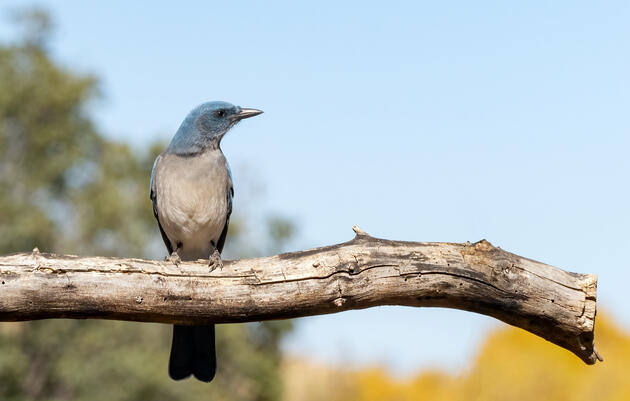
Perhaps the most exciting trend in the bunch comes from our volunteers. Starting with just 17 volunteers in 2007, we hit an all-time high this year with 49! The effort would not be possible without them, and we’re happy to report that with comfortable weather and great birding companions, all had a wonderful time in the field. Highlights included two new species for the count – Lawrence’s Goldfinch and Sage Thrasher, regular rarities like Gilded Flicker and Townsend’s Solitaire, and for one group, a lifer Woodhouse’s Scrub Jay.
Thank you to everyone who joined us for this year’s Appleton-Whittell Christmas Bird Count. Check out our website to learn more about the effort and how to get involved, and while you’re there, check out the latest addition to the count – a selection of accessible birding locations within the count circle!
Interested in past years' results? Follow the instructions below to access Audubon's CBC data portal.
- In your internet browser, navigate to the data portal.
- At the top, hover over "historical" to reveal a drop-down menu and select "results by count".
- Select a date range, select "United States" as your country and "Arizona" as your state, and in the resulting dropdown select "Appleton-Whittell".
- Explore the data! Start back at step one to explore different dates or counts. The most recent data will be posted as it becomes available.